
Projected vs Actual Release Date
A projected release date is a calculated or eligibility-based date, not a guarantee that someone will walk out of custody on that exact day. In Imperial County, the phrase can mean different things depending on the source. For county jail, it may be an internal estimate based on a jail sentence, credits, and release processing. For CDCR, the public vocabulary includes an Earliest Possible Release Date or other parole eligible date. For BPH cases, a grant or scheduled hearing is part of the release path, not the final custody exit by itself.
Scheduled is not final. A scheduled or projected date can move because of a new court order, credit recalculation, discipline, a detainer, a parole-board outcome, transport, identity confirmation, or another agency hold. The actual release record is the custody event showing the person left that agency's custody.
Pretrial detainees at the Regional Adult Detention Facility, Herbert Hughes Correctional Center, or Oren R. Fox Detention Facility do not have a sentence-based release date unless the court has imposed a custody term or ordered release. A posted bond, dismissal, no-complaint decision, court order, time-served sentence, probation grant, or transfer can end county jail custody. That is why court records and sheriff records matter as much as any online search.
Find an Imperial County Inmate's Release Date
The fastest path is to separate county jail, CDCR state prison, federal custody, and ICE custody before searching. Imperial County has all four kinds of custody sources nearby, so a person can leave one system and remain in another. A release from county jail to CDCR, ICE, USMS, or another county is not community release.
- Start with the custody location. County jail means the Imperial County Sheriff's Office Corrections Division. Calipatria State Prison or Centinela State Prison means CDCR. El Centro Detention Facility means federal/USMS. Imperial Regional Detention Facility means ICE.
- For county jail, call Jail & Inmate Information at (442) 265-2266 for current or recent custody status. Use Records at (442) 265-2125 and the Booking Summary Request form for formal release-date proof.
- Use Imperial Superior Court records to explain why jail custody ended. Public ROA/Case Lookup can show disposition, sentence, probation, dismissal, or commitment entries when the case is public.
- For CDCR, open CIRIS at https://ciris.mt.cdcr.ca.gov/. Search by CDCR number if known, or by name, then compare age, commitment county, current location, admission date, and BPH dates or outcomes.
- Read the official CDCR/BPH date label. California does not use one universal public label for every sentence; look for EPRD, MEPD, NPED, YPED, EPED, or controlling parole eligible date language.
- If the person is already released and no current CDCR result appears, use CDCR case records, the release institution, DAPO, PRCS/probation, VINE, and court records instead of treating the absence as proof.
- For federal custody, use the BOP locator for people in BOP custody or released from BOP custody since 1982. For USMS pretrial or presentence custody, use the federal court and USMS/facility path.
- For ICE custody, use the ICE Online Detainee Locator and facility contact. ICE release, transfer, removal, or bond is separate from an Imperial County criminal jail release.
For a named-person search across these channels, the Imperial County released inmates home page explains how sheriff records, CDCR, VINE, court records, BOP, and ICE fit together.
CDCR Date Terms for Imperial County Cases
CDCR's California Incarcerated Records and Information Search is the public state-prison search. CA.gov describes CIRIS results as including name, CDCR number, age, current location, commitment counties, admission date, and Board of Parole Hearing dates and outcomes for people currently in CDCR custody. BPH says the controlling parole eligible date is available through CDCR's search engine.
| Term | What it means in California release-date research |
|---|---|
| EPRD | Earliest Possible Release Date for a determinately sentenced person, based on the court sentence minus applicable credits. |
| MEPD | Minimum Eligible Parole Date for a person serving an indeterminate life-with-parole sentence. |
| NPED | Nonviolent Parole Eligible Date under Proposition 57 for qualifying cases, with exclusions described by BPH. |
| YPED | Youth Parole Eligible Date for qualifying people who committed the controlling offense while under age 26, subject to statutory timing and exclusions. |
| EPED | Elderly Parole Eligible Date for qualifying people by age and time served, with exclusions. |
| Controlling parole eligible date | The earliest applicable opportunity for parole consideration or release when more than one date applies. |
These terms are for CDCR and BPH state-prison research. They should not be applied to a person in Imperial County Jail unless the person has been committed or transferred into the CDCR system.
Good-Time Credit and Computed Dates
California release dates are heavily affected by credits, but county jail and state prison credits are not the same system. Penal Code section 4019 governs many local custody conduct-credit calculations. Penal Code section 2933 governs state-prison worktime credits. Penal Code section 2933.1 limits people convicted of violent felonies listed in Penal Code section 667.5(c) to no more than 15 percent worktime credit, which is the source for the common California "about 85 percent" framing in violent-felony cases. Penal Code section 2933.2 creates additional restrictions for murder.
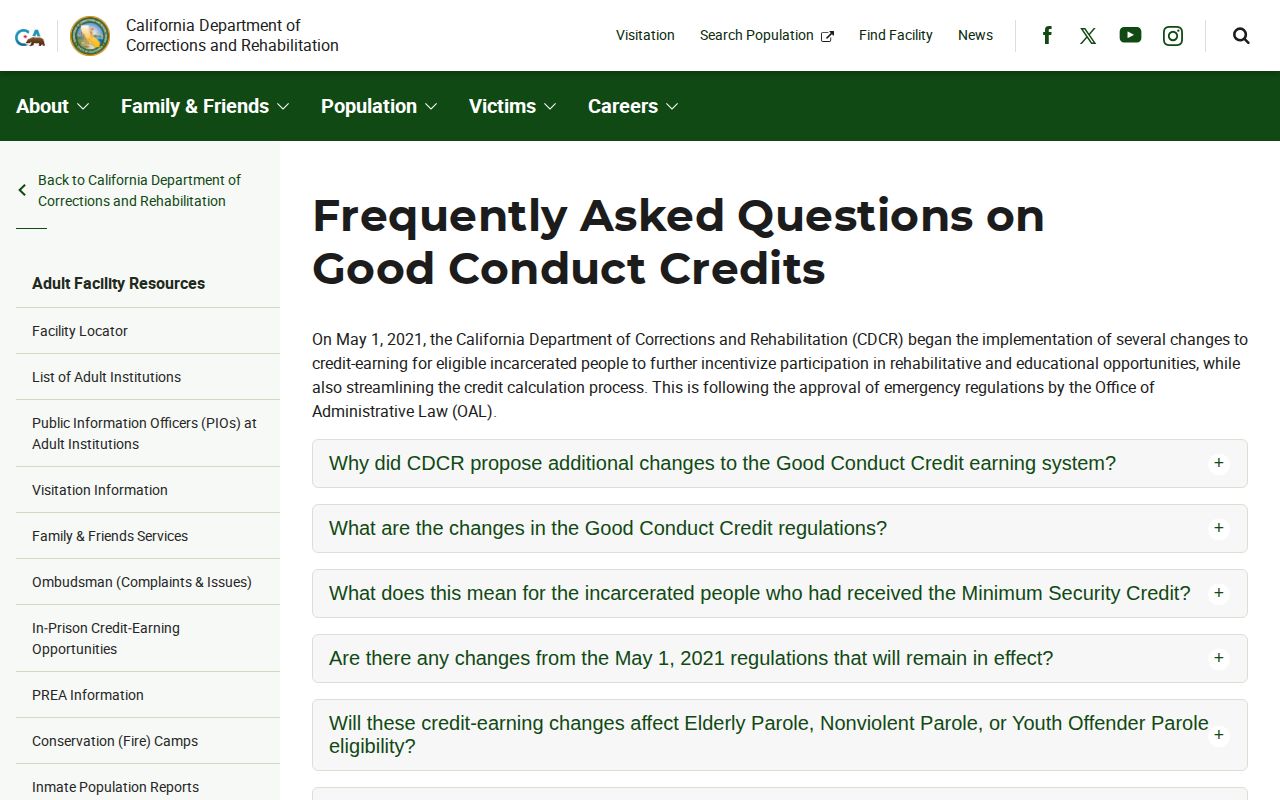
CDCR's Proposition 57 materials describe Good Conduct Credit and program-related credits, including Milestone Completion Credits, Rehabilitative Achievement Credits, Educational Merit Credits, and Extraordinary Conduct Credits. CDCR's Good Conduct Credit FAQ explains that effective May 1, 2021, credit-earning was streamlined so many eligible nonviolent cases earn 50 percent, many violent cases earn 33.3 percent, some eligible nonviolent fire-camp or minimum-custody cases can earn 66.6 percent, and some eligible violent fire-camp cases can earn 50 percent. The exact application depends on workgroup, conviction type, discipline, and CDCR calculation.
The safest way to discuss an Imperial County projected date is to name the source. For a jail sentence, ask the sheriff's records channel and review the court commitment. For a CDCR sentence, use CDCR/CIRIS and CDCR records. For a parole-suitability case, use BPH schedules and results, then confirm any actual release through CDCR.
Imperial County Worker-Credit Detail
Imperial County's jail page includes one locally distinctive credit detail that should not be generalized to every jail detainee. The sheriff states that incarcerated workers must work more than 30 days to obtain six days of work credit. The same jail page says AB 109 workers serving state prison in a county facility are granted no more than six weeks work credit per year under AB 624, with educational programming required.
That local worker-credit detail helps explain why a county jail release estimate can change, especially for sentenced workers or AB 109 populations. It is separate from CDCR's Proposition 57 credit system and separate from the statutory 15 percent cap for violent felonies under Penal Code section 2933.1. Use it as a program-specific county jail detail, not as a universal formula for every Imperial County release date.
Why a Projected Release Date Changes
Projected dates change because custody data changes. A court may correct a sentence, CDCR may recalculate credits, BPH may grant or deny parole, or another agency may place a hold. A date can also move because release processing takes time even after the legal basis for release is complete.
| Change factor | How it affects the release date |
|---|---|
| Court order or amended minutes | A dismissal, resentencing, corrected abstract, probation order, or jail commitment can shorten, extend, or end custody. |
| Credits | Conduct, work, program, educational, or good-conduct credits can be earned, forfeited, restored, or recalculated. |
| Discipline or classification | CDCR workgroup status or jail program status can affect credit earning and projected-date recalculation. |
| Detainers and holds | Another county warrant, CDCR commitment, federal/USMS hold, ICE transfer, or probation/parole violation can keep the person in custody after the first agency releases. |
| BPH result | A Grant, Deny, Continue, Cancelled, Split, Postpone, Waive, or Stip result affects state-prison parole timing, but a grant still requires review before final release. |
| Administrative release processing | Transportation, identity confirmation, medical clearance, property, paperwork, and release-funds processing can affect the actual time of release. |
County Jail Date vs CDCR Date
The sheriff's jail record and CDCR record answer different questions. The Imperial County Sheriff's Office operates the Regional Adult Detention Facility, Herbert Hughes Correctional Center, and Oren R. Fox Detention Facility. A person booked locally may be released on bond, court order, time served, dismissal, probation, transfer, or another hold. The sheriff's booking summary and the court case are the strongest local sources for that custody event.
Calipatria State Prison and Centinela State Prison are CDCR facilities. A person released from either prison should be checked through CDCR, BPH, DAPO parole, PRCS/probation if assigned locally, and court records. The county sheriff's booking-summary process does not prove a Calipatria or Centinela release unless there was also a separate Imperial County jail booking.
Confirming a Release Date
For a pending county jail release, confirm with Jail & Inmate Information at (442) 265-2266, check California VINE if the person is in a participating custody record, and use the sheriff's Booking Summary Request form for formal proof. For a pending state-prison release, use CDCR/CIRIS, CDCR records, the release institution, DAPO, PRCS/probation where applicable, and BPH records if the person has a parole-hearing path. For a notification rather than a formal record, use the VINELink Check page to register for release or transfer alerts.
When a date matters for a court filing, custody handoff, or certified record, rely on the originating agency record rather than a screenshot alone. Imperial Superior Court copy records may show the sentence, minute order, dismissal, probation grant, or certified disposition. The court's Criminal Division lists copy and certification fees, and sealed or confidential cases are not available through the public portal.