
Parole vs Probation in Imperial County
A released Imperial County person is not automatically on parole. In California, parole usually means state supervision after a CDCR prison release. Probation usually means a Superior Court sentence or supervision term handled locally by the Imperial County Probation Department. Imperial County also has PRCS and mandatory supervision, which matter because AB 109 realignment moved some people who would once have been handled through state prison or state parole into county-supervised systems.
Key distinction. Parole follows a state-prison case and is handled through CDCR's Division of Adult Parole Operations. Probation, PRCS, and mandatory supervision are local supervision categories tied to Imperial County Superior Court and Imperial County Probation. A jail release record can show that custody ended, but the court and supervising agency explain what supervision followed.
| Supervision type | Who handles it | When it usually applies |
|---|---|---|
| CDCR parole | CDCR Division of Adult Parole Operations, with the El Centro satellite listed under Chula Vista 2 | After release from a CDCR state prison to parole, including some releases from Calipatria State Prison or Centinela State Prison |
| County probation | Imperial County Probation Department Adult Services | When the Superior Court grants probation, sometimes after a county jail term served as a condition |
| PRCS | Imperial County Probation Department | For eligible people released from CDCR who are supervised locally instead of by state parole |
| Mandatory supervision | Imperial County Probation Department | For qualifying local sentences where part of the term is served in custody and part under county supervision |
| Federal supervised release | U.S. Probation Office, Southern District of California | After a federal sentence or federal court supervision term, separate from the Imperial County jail record |
The Imperial County Sheriff's Office is still important because it holds the county jail booking and release record for people released from RADF, Herbert Hughes Correctional Center, or Oren R. Fox Detention Facility. But the sheriff's jail record does not create a public probation list, and CDCR's CIRIS search is not a county probation lookup. Treat the custody record, court case, and supervision record as related but separate records.
Verify Imperial County Post-Release Supervision
The practical verification question is: is this released Imperial County person on parole, probation, PRCS, mandatory supervision, or something else? Start with the agency that controlled custody at the time of release. A person released from a county jail facility may have a sheriff booking summary and a Superior Court case. A person released from CDCR may have CIRIS, BPH, DAPO, or PRCS records. A federal person held at El Centro Detention Facility follows the federal court and U.S. Probation path.
- Identify the releasing custody system. Use Imperial County Jail records for RADF, Herbert Hughes Correctional Center, or Oren R. Fox; use CDCR/CIRIS for state-prison custody; use federal or ICE channels for those facilities.
- Check the court case. Imperial County Superior Court ROA/Case Lookup can show public case events such as probation, sentence, dismissal, CDCR commitment, or revocation entries. Sealed and confidential cases do not appear publicly.
- For state parole, review CDCR information and BPH records. CIRIS can show current CDCR custody details and BPH dates or outcomes for people currently in CDCR custody. The BPH hearing-results page can show recent parole-suitability outcomes.
- For county supervision, use Imperial County Probation Adult Services information. Probation says it does not release who is on probation to the public because of confidentiality issues, so do not expect a public probationer roster.
- Use VINE for custody status and notifications when the person is still in a participating custody record. VINE can notify about release or transfer, but it is not the formal supervision record.
- Request the sheriff booking summary or release record when the question is whether the person left county jail. Jail & Inmate Information is (442) 265-2266, and Records is (442) 265-2125.
For a broader release-record path, the Imperial County released inmates home page covers county booking summaries, court records, CDCR, VINE, and federal/ICE fallbacks together. This page stays focused on what happens after release when a supervision agency is involved.
Imperial County Supervising Offices
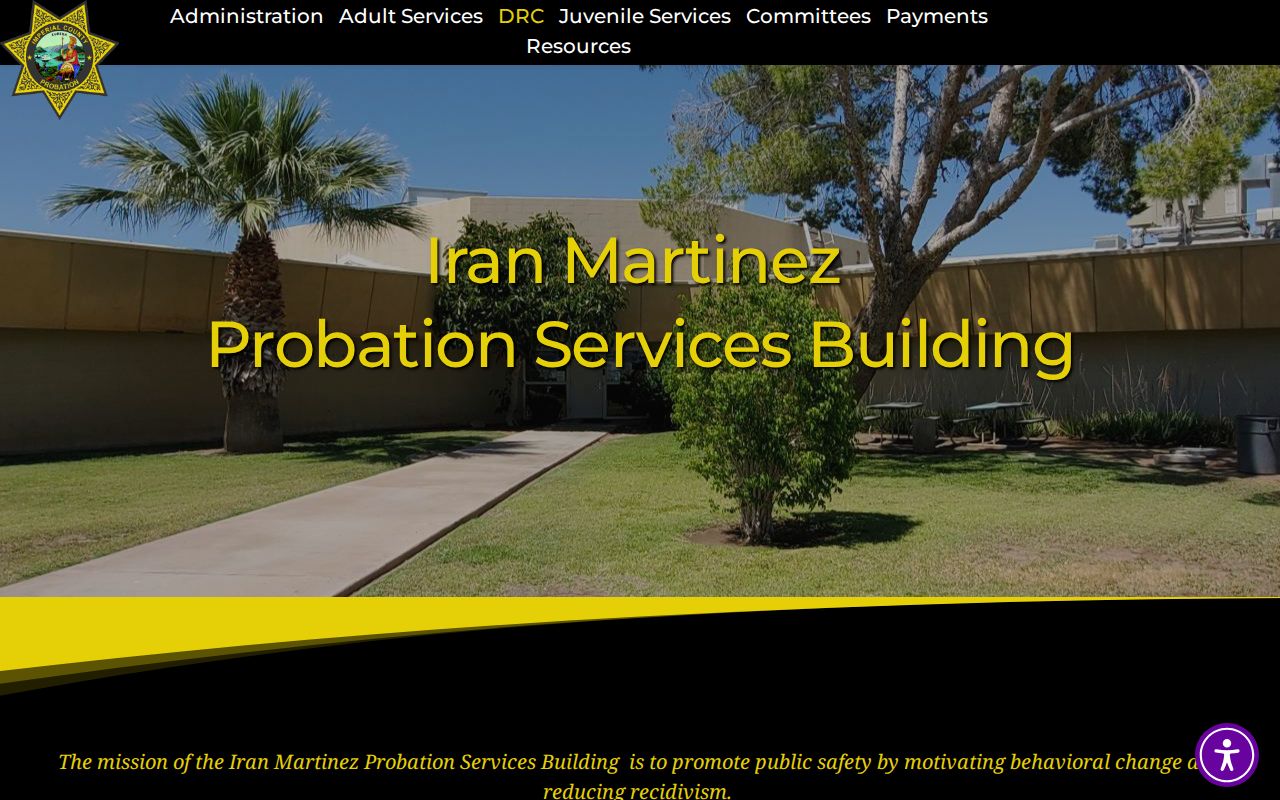
Imperial County has a local CDCR parole presence and a separate county probation system. The CDCR Division of Adult Parole Operations Southern Region directory lists the Chula Vista 2 satellite office in El Centro. Imperial County Probation's Adult Services page documents probation, mandatory supervision, PRCS, AB 109, adult investigations, and adult supervision. The Day Reporting Center adds a local reporting and services point for supervision workflows.
CDCR parole in El Centro
CDCR Division of Adult Parole Operations
Chula Vista 2 satellite office
279 South Waterman Avenue
El Centro, CA 92243
(760) 352-7524
Imperial County Probation
Day Reporting Center
324 Applestill Road
El Centro, CA 92243
(442) 265-2520
Monday-Friday, 8 a.m.-5 p.m.
Probation's local materials say GEO Re-Entry Services is located within the Day Reporting Center as a point of contact for cognitive-behavioral programs. That is relevant to navigation after release, especially for people on PRCS or mandatory supervision, but it should not be treated as a public custody database.
BPH Hearings and Parole Outcomes
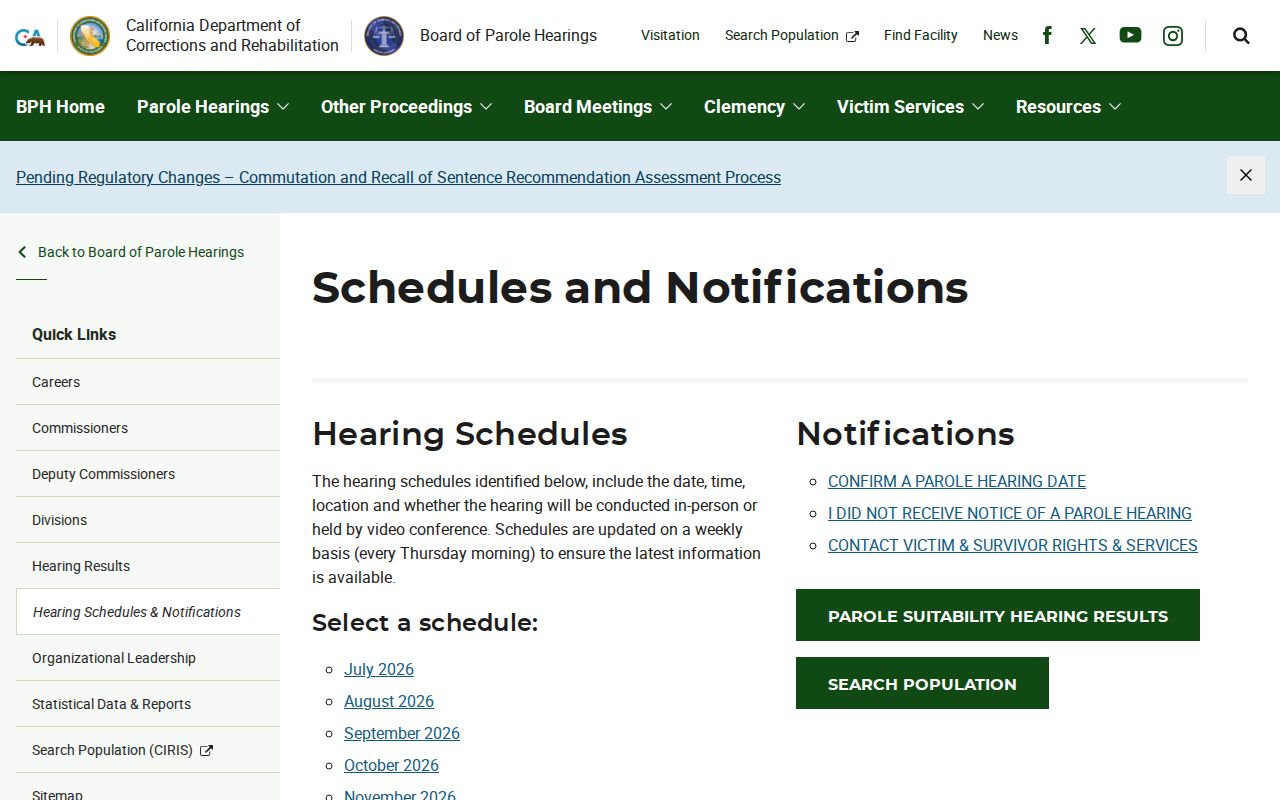
For state-prison cases, the California Board of Parole Hearings is part of CDCR and handles parole suitability proceedings and related reviews. BPH states that hearing schedules are updated weekly every Thursday morning and list the date, time, location, and whether a hearing will be in person or by video conference. BPH also publishes recent parole-suitability hearing results by week and month.
Results have specific meanings. A Grant is a finding of suitability and a recommendation for release to parole, but BPH says it is still subject to Legal Division and Governor review before becoming final. Deny means the person was found unsuitable. Continue means a hearing started but was not completed. Cancelled can include a court-ordered release or death. Split, Postpone, Waive, and Stip are also BPH outcome terms. None of these terms should be converted into an actual release date without checking CDCR records and the final release process.
BPH's eligibility page uses California's official release-date vocabulary: EPRD for determinately sentenced people, MEPD for indeterminate life-with-parole cases, NPED for some nonviolent parole reviews, YPED for qualifying youth parole cases, and EPED for qualifying elderly parole cases. The controlling parole eligible date is the earliest applicable opportunity for consideration or release and is publicly available through CDCR's search.
Conditions, Violations, and Absconders
Supervision conditions are case-specific. CDCR parole conditions are prepared during release processing, and CDCR says parole supervision levels are assigned immediately before release and may change as reintegration progresses. County probation, PRCS, and mandatory supervision conditions come from the court order and Probation Department process. A person may be required to report, obey laws, comply with searches or treatment terms, pay restitution, attend programming, or follow travel limits if those conditions apply to the case.
Violation records can point back to multiple agencies. A probation violation may return a person to Imperial County Jail. A parole violation may involve CDCR parole and local jail custody. AB 109 matters because Imperial County Probation explains that some parole violators are revoked to local county jail rather than state prison, except for life-with-parole cases. A VINE alert may show a custody change, but the court and supervising agency explain why the change happened.
Absconder or wanted status should be handled carefully. CDCR publishes a wanted sex offender list through DAPO for certain cases, and California Megan's Law covers registry-qualified community status. Those lists do not include every released person and should not be used as a general released-inmate search. If a person is missing from a registry or wanted list, that absence does not prove they are not under supervision.
AB 109 and PRCS in Imperial County
Imperial County Probation's Adult Services material gives a strong local explanation of AB 109 realignment. AB 109 took effect October 1, 2011 and shifted certain nonviolent, nonserious, non-sex new-law sentences and supervision groups from state systems to counties. The department explains that PRCS officers supervise local clients who, before AB 109 and AB 117, would have been released from CDCR and supervised by state parole.
This is why a person released from CDCR to Imperial County may not be on state parole. If the most recent conviction meets PRCS eligibility rules, county probation may supervise after the CDCR release. Probation also says PRCS clients are transported immediately to the Probation Department's Community Transition Center for assessments and service connections. For record verification, use CDCR to confirm the state-prison custody and release path, then use probation or court records where the case authorizes local supervision information.
Records, Reporting, and Release Navigation
Imperial County research has limited public detail on property return or document pickup, but the release-navigation path is clear. The sheriff's jail information and records contacts handle county custody questions and booking-summary requests. The Superior Court handles disposition copies, sentencing minutes, probation grants, dismissals, and other public case documents. Probation handles supervision reporting after sentencing or release from jail where the person is under county supervision.
For a released county-jail person, start with the sheriff's Records Division at 328 Applestill Road, El Centro, Monday-Friday, 8:00 a.m.-4:30 p.m., or call Records at (442) 265-2125. For a state-prison person, use CDCR, BPH, DAPO, and PRCS as applicable. For a federal supervised-release case, the U.S. Probation Office for the Southern District of California has an El Centro office at 2003 West Adams Avenue, Suite 110, El Centro, phone 760-339-4220. That federal path is separate from county probation.
How Imperial County Supervision Ends
Supervision ends through the agency and court authority that created it. Probation can end by completion, court order, violation disposition, modification, revocation, or relief such as a Penal Code section 1203.4 dismissal in eligible cases. PRCS and mandatory supervision end under the local supervision order and applicable law. CDCR parole can end by discharge, revocation outcome, court order, or other CDCR process. BPH eligibility and suitability records may explain why a state-prison person was considered for parole, but the actual post-release status belongs to CDCR parole or local PRCS once release occurs.
Public-record boundaries still apply. Imperial County Probation says it does not release who is on probation to the public because of confidentiality issues. California public-records law may allow access to some arrest and release information while protecting investigative, sealed, juvenile, medical, victim, or confidential information. A released person dropping off a jail roster is not the same as an erased record, and a sealed case may explain why public results are limited.